
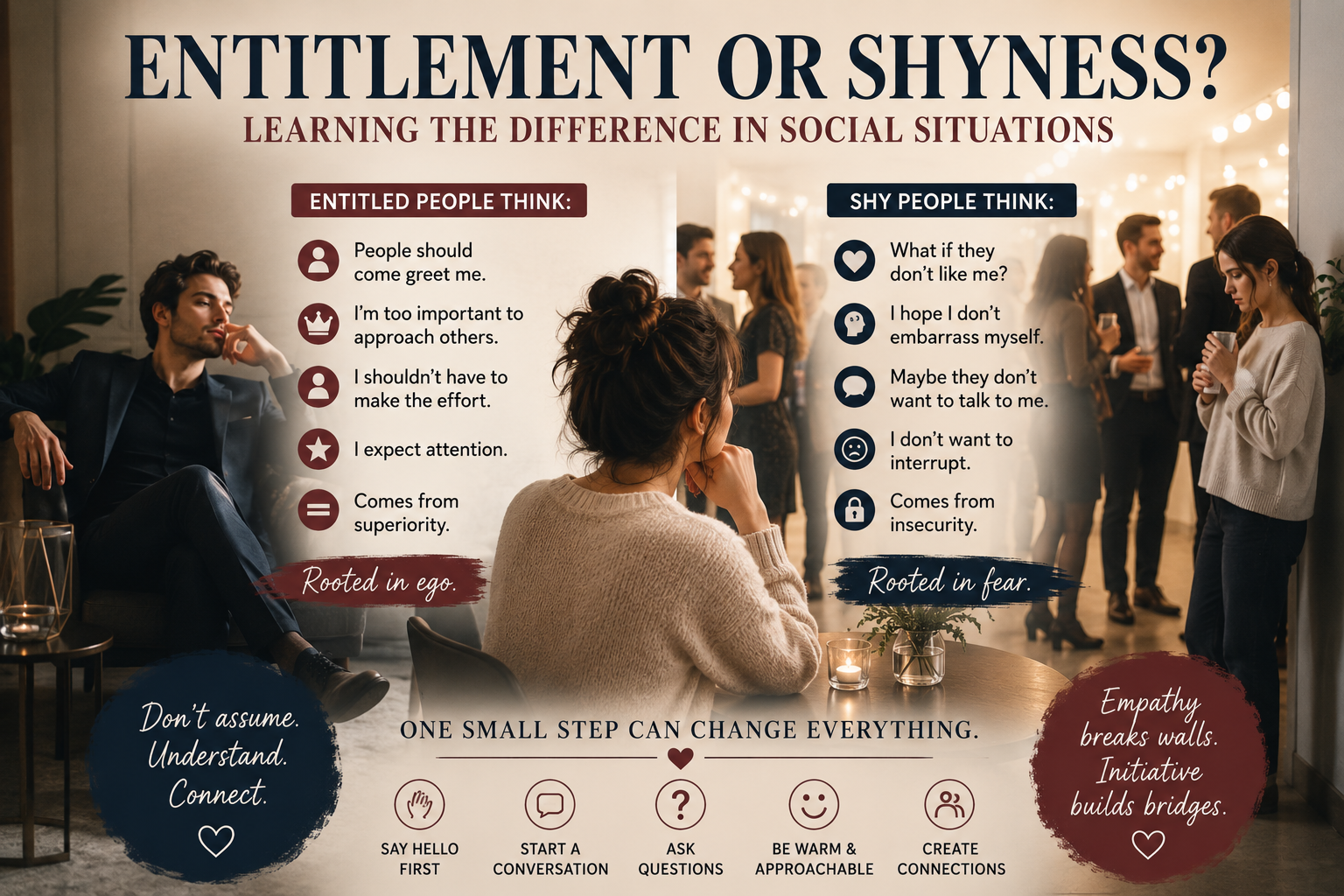
Entitlement or Shyness? Learning the Difference in Social Situations
For years, people probably assumed I was confident because I could speak professionally, run meetings, and handle responsibilities. What many did not realize was that in unfamiliar social situations, I often felt just as nervous as anyone else.
I was not avoiding people because I felt superior. Quite the opposite. Sometimes I worried about saying the wrong thing, interrupting a conversation, or making an awkward first impression.
That experience taught me something important:
Shyness and entitlement can sometimes look surprisingly similar from the outside, even though they come from completely different places internally.
Walk into almost any party, family gathering, networking event, or dinner, and you will notice two kinds of people almost immediately.
One person walks in, smiles, introduces themselves, shakes hands, and starts conversations naturally.
Another person quietly sits in the corner waiting for someone to approach them first.
From the outside, those two situations can be misinterpreted.
People may think:
“Why are they sitting there expecting everyone to come to them?”
But the truth is, not everyone who stays quiet is entitled.
Many people are simply shy, socially anxious, insecure, uncertain, or afraid of rejection.
The challenge is that entitlement and shyness can sometimes look identical on the surface while being driven by completely different emotions.
Understanding the difference matters because misjudging people can damage relationships, create unnecessary misunderstandings, and prevent personal growth.
The Difference Between Entitlement and Shyness
At first glance, both people may appear passive.
Neither initiates conversation.
Neither walks across the room to introduce themselves.
But internally, their mindset is completely different.
A Shy Person Thinks:
- What if they do not like me?
- I do not want to interrupt.
- I hope I do not embarrass myself.
- Maybe they do not want to talk to me.
- I am nervous.
An Entitled Person Thinks:
- People should come greet me.
- I should not have to make the effort.
- I am too important to approach others.
- If they want to talk, they can come to me.
- I expect attention.
One comes from insecurity.
The other comes from superiority.
That distinction changes everything.
Why People Often Misinterpret Shyness
Unfortunately, social settings rarely allow us to see what is happening inside someone’s mind.
Most people can only see behavior, not the thoughts and emotions behind it.
When someone sits quietly and avoids initiating conversation, observers may assume:
- Arrogance
- Pride
- Disinterest
- Coldness
- Snobbishness
- Entitlement
Meanwhile, the shy person may be fighting an internal battle just to remain in the room.
This misunderstanding happens constantly in schools, workplaces, churches, parties, weddings, and business events.
Many socially anxious people unintentionally appear distant when they actually crave connection more than anyone else.
How Background and Upbringing Shape Social Behavior
A person’s background often influences how they behave socially far more than people realize.
1. Childhood Environment
Children raised in highly critical households may become fearful of saying the wrong thing.
If they were constantly corrected, judged, or embarrassed growing up, they may learn that staying quiet feels safer than speaking up.
2. Lack of Social Exposure
Someone who was isolated, frequently excluded, bullied, or simply lacked opportunities to socialize may never develop confidence initiating conversations.
Social skills are learned through repetition.
People who do not receive enough practice often freeze in adult social situations.
3. Trauma or Rejection
Past humiliation can create hesitation that lasts for years.
A person who has experienced repeated rejection may subconsciously believe:
- People probably do not want me around.
- I will look foolish.
- I will say something awkward.
So instead of approaching others, they wait until they feel safe.
4. Overprotective Parenting
Some people were never encouraged to independently navigate social situations.
Parents may have spoken for them, protected them excessively, or shielded them from discomfort.
As adults, initiating conversations can feel unfamiliar and intimidating.
5. Cultural Conditioning
In some cultures and families, being quiet is viewed as respectful and polite.
Speaking first may even feel aggressive or intrusive.
What appears shy in one environment may actually be considered proper behavior in another.
When Shyness Becomes a Problem
Shyness itself is not bad.
Many thoughtful, intelligent, kind, and highly successful people are naturally introverted.
The problem begins when shyness starts controlling opportunities and relationships.
Excessive hesitation can:
- Limit career growth
- Reduce opportunities for friendship
- Create loneliness
- Affect dating relationships
- Lower confidence
- Cause others to feel unintentionally ignored
People may never discover your personality if fear consistently keeps you silent.
That is why learning to initiate socially is one of the most valuable life skills a person can develop.
How Fear Creates the Outcome We Fear
One of the most frustrating things about shyness is that it often creates the very outcome we are trying to avoid.
We fear being ignored, so we stay quiet.
We fear rejection, so we avoid approaching people.
We fear awkwardness, so we remain on the sidelines.
Then we leave feeling disconnected and wonder why nobody talked to us.
The reality is that many people may have been waiting for us just as much as we were waiting for them.
Sometimes the only thing standing between loneliness and connection is a simple introduction.
The Power of Saying Hello First
The person who initiates conversation often gains enormous advantages in life.
Not because they are better.
Because they create momentum.
When you walk up first and introduce yourself:
- You reduce tension
- You make others feel comfortable
- You appear confident
- You become memorable
- You create opportunities
Most people are far more nervous than they appear.
Ironically, a room is often filled with people all waiting for someone else to make the first move.
The person who breaks the silence becomes socially magnetic.
Why Taking Initiative Makes You Stand Out
Confidence is attractive because it communicates emotional security.
When someone smiles and says:
“Hi, I’m John. Nice to meet you.”
They immediately appear:
- Approachable
- Mature
- Self-aware
- Socially intelligent
- Emotionally strong
People naturally gravitate toward warmth and openness.
Meanwhile, someone who waits passively can unintentionally seem disconnected, even if that was never their intention.
Initiating conversation also demonstrates leadership.
But leadership is not limited to boardrooms, businesses, or positions of authority.
Sometimes leadership is simply being the person willing to make others feel welcome.
The first smile.
The first handshake.
The first hello.
Small acts of initiative often create the strongest social connections.
How We Should Interpret Quiet People
It is important not to judge reserved people too quickly.
Some quiet individuals are:
- Deeply thoughtful
- Emotionally intelligent
- Highly observant
- Processing information
- Simply nervous
Rather than assuming arrogance, try offering warmth first.
A friendly introduction, a smile, or a simple question can completely change someone’s experience of an event.
A little empathy goes a long way.
This Week’s Social Challenge
The next time you attend a gathering, challenge yourself to:
✅ Introduce yourself to one new person.
✅ Ask three questions before talking about yourself.
✅ Smile and make eye contact when entering the room.
✅ Start one conversation instead of waiting for one.
You do not need to become the most outgoing person in the room.
You simply need to become slightly braver than you were yesterday.
Final Thoughts
The line between entitlement and shyness is often invisible from the outside but completely different on the inside.
Entitlement says:
“I deserve attention.”
Shyness says:
“I am afraid to reach for connection.”
One is rooted in ego.
The other is rooted in fear.
But regardless of where someone starts, growth is possible.
The people who learn to walk across the room, introduce themselves, and create connection often discover that life opens up in surprising ways.
Friendships form faster.
Business opportunities increase.
Relationships deepen.
Confidence grows.
The strongest social skill is not perfection.
It is not popularity.
It is not having the perfect words.
It is the willingness to reach out despite uncertainty.
Most meaningful relationships begin with one person taking a small risk and saying hello.
You never know which conversation could become a friendship, an opportunity, a partnership, or a life-changing connection.
Sometimes the courage to go first changes far more than a single conversation—it can change your entire life.